
Official Gulf County Arrest News
Start with the Gulf County Sheriff's Office News Digest when you want an agency's own account of an arrest. Sheriff Mike Harrison heads GCSO. Some posts carry a named narrative and an agency-supplied image. Not every arrest makes the digest. Treat it as selective, not a full blotter. A separate GCSO Arrests page rolls recent bookings forward, and photos stay visible for roughly two weeks. Even that list won't show who sits in custody right now.
Plenty of other agencies feed local outlets: Port St. Joe police, the Florida Highway Patrol, FDLE, federal agencies, prosecutors, and the courts. Pay attention to who said what. A story crediting GCSO may rest on an early release, while a later court filing can list different charges or a different outcome. The county-run Gulf County Detention Facility keeps detention records, and the Gulf Clerk holds the criminal docket. Neither one doubles as the sheriff's newsroom. None substitutes for the other.
The official Gulf County recent-arrest publication is covered in full alongside the county booking channels.
Note: Someone can be absent from sheriff news and still have an arrest or court record on file with the proper custodian.
Gulf County Crime News Outlets
No single daily crime wire serves Gulf County. Local reporting picks events rather than logging every call. The strongest archive belongs to The Port St. Joe Star's GulfCounty.news, while WJHG/WECP NewsChannel 7 runs a broader Gulf feed. Other publications add narrower community or regional context. Silence from any of them proves nothing.
| Outlet | Coverage | Photos? | Where |
|---|---|---|---|
| GCSO News Digest | Selected sheriff investigations, arrests, and public-safety releases | Sometimes agency images | Official digest |
| The Port St. Joe Star / GulfCounty.news | Selected county crime, investigation, and court stories | Inconsistent; agency or editorial images | Crime archive |
| WJHG/WECP NewsChannel 7 | Rolling all-topic Gulf County feed with selected crime reports | Sometimes mugshots supplied by an agency | Gulf County page |
| The Wewa News | Wewahitchka and north Gulf community news | No recurring mugshot feature found | Publication archive |
| Calhoun-Liberty Journal | Occasional GCSO or north-Gulf item; main log serves neighboring counties | Varies by item | Area Arrests |
| WMBB/MyPanhandle | Individual Gulf arrest stories surfaced | Varies | No stable Gulf crime landing was verified |
The table keeps each outlet in its proper role. The Wewa News bills itself as "Good News and Whatever." It shows no crime category and no arrest-log pattern. The Calhoun-Liberty Journal may pick up north-Gulf material. Still, its regular arrest list centers on Calhoun and Liberty counties. WMBB stories can help when you find them, yet a blocked or unstable tag page makes a poor Gulf County index.
Gulf County Mugshots in News
The GulfCounty.news Crime archive is the county's strongest dedicated local section. It stretches across several archive pages. Coverage includes Port St. Joe and Wewahitchka. Stories there credit sources like GCSO, FDLE, the medical examiner, and federal court. Publishing runs in bursts. Several items may land in one month, followed by a long quiet stretch. That pattern makes it a curated newsroom archive, not a daily booking list.

Local crime stories cluster in one spot on the site. Agency and court sources still anchor any record check.
WJHG's Gulf County news page blends crime reporting with weather, government, and other county coverage. Reporters there cite GCSO, Port St. Joe police, FHP, FDLE, or the courts. Video and still images appear often, and a booking photo may run when an agency supplies one. There is no standing mugshot gallery and no set posting schedule. A regional TV report gives fast context, but the named source and the docket still carry the record check.
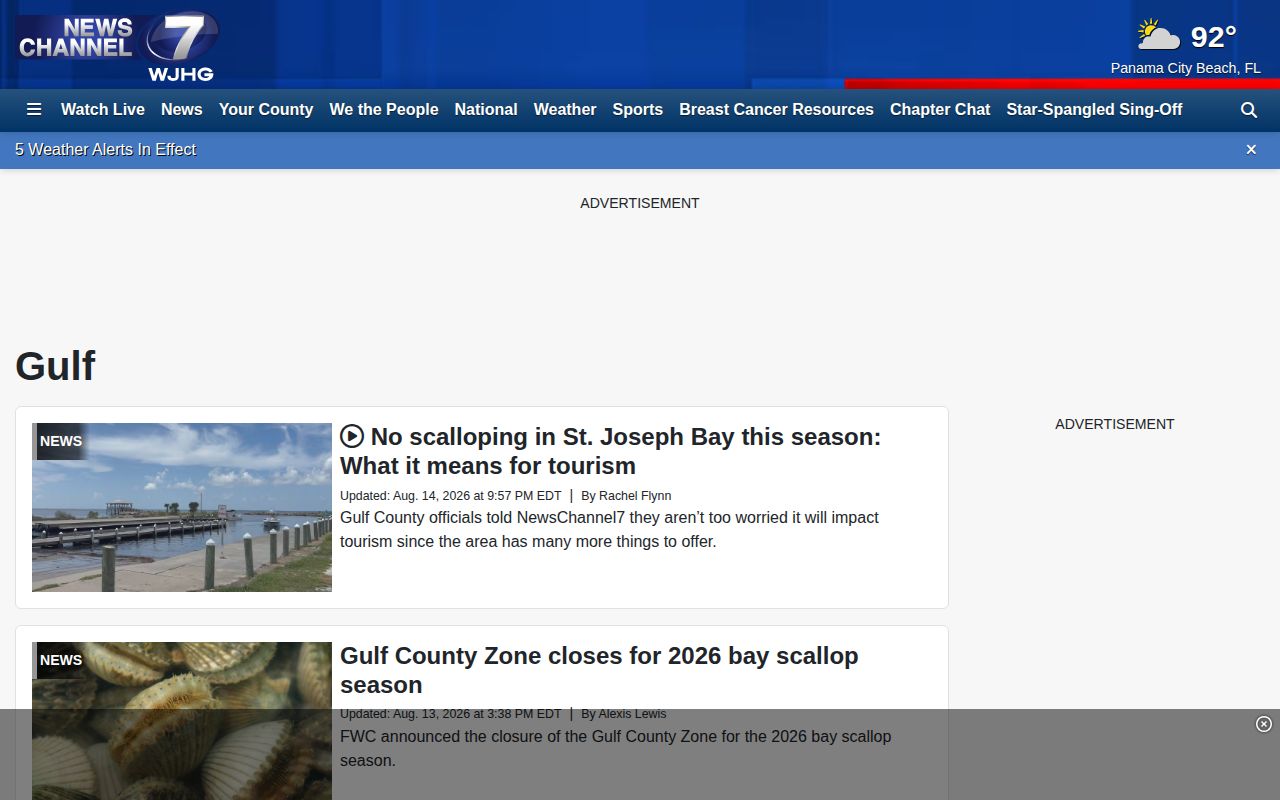
The WJHG capture documents a county news landing, not a complete arrest log or a current-custody roster.
Unofficial Gulf County Mugshot Sources
Third-party county pages sit behind the official and local-news sources. They lag. They omit cases, mislabel cities, and sometimes leave old material standing after a case changes. Their update windows and record counts are publisher claims, not Gulf County promises. Treat them as leads only, and verify every key point with GCSO, the detention facility, or the Gulf Clerk.
| Publisher | Gulf County Finding | Reliability Limit |
|---|---|---|
| RecentlyBooked | Live county section claiming a 30-day window and multiple daily refreshes | Unofficial publisher claims; no separate city pages |
| Arrests.org | County landing with filters and year paths; zero recent results during research | An empty page does not prove no arrests; data can be incomplete |
| Mugshots.com | County and city filters, with visible years ending in 2021 during research | Stale and sometimes mismatched place labels |
| BustedNewspaper | No Gulf County page found in its Florida county index | Do not substitute a neighboring county page |
| Mugshots.zone | No verifiable Gulf, Port St. Joe, or Wewahitchka section found | Returned an error; no local link is offered |
RecentlyBooked's live Gulf section shows how a secondary publisher arranges county material. Read the unofficial Gulf County page with its source limits and freshness limits in plain view.
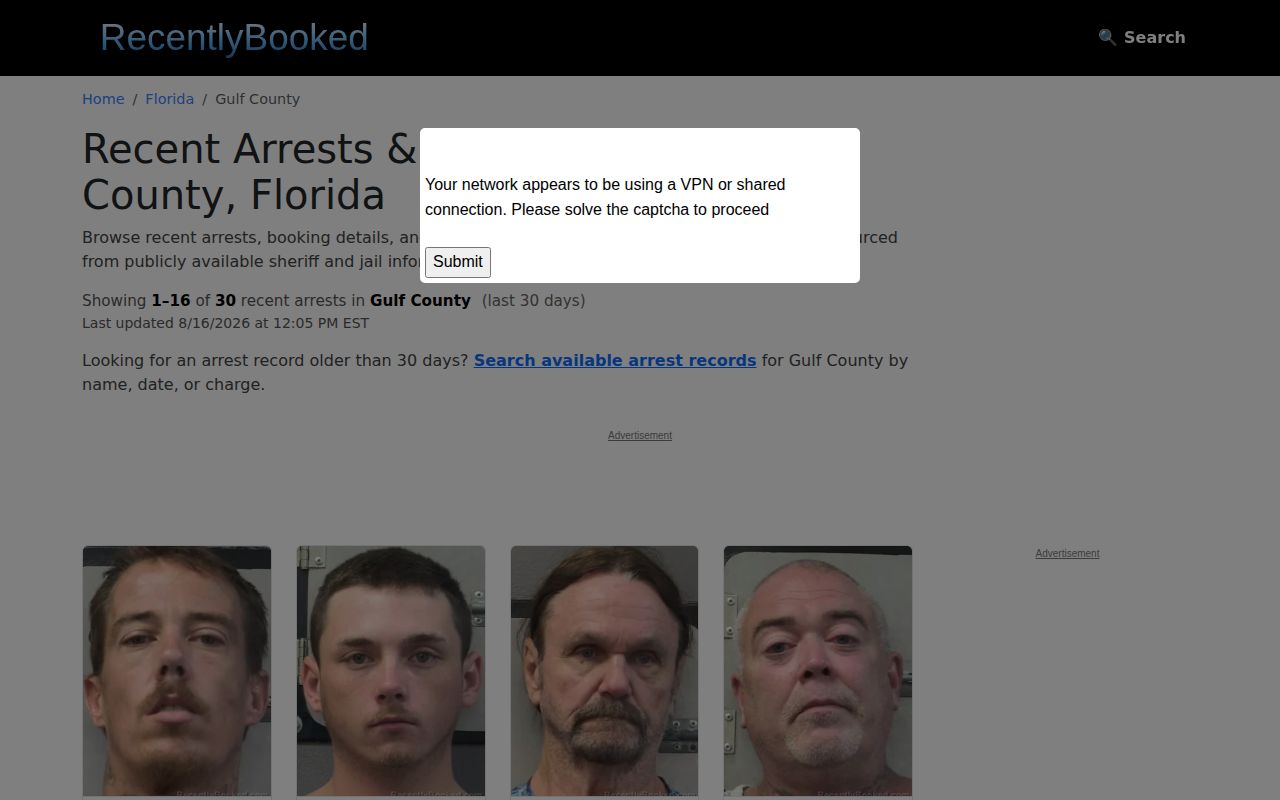
This capture documents one optional publisher in the local landscape. It replaces nothing official. The recent-arrest page, the custody system, and the courts still come first.
Arrests.org offered a useful warning of its own. A real county landing can sit empty. Mugshots.com's apparent archive ended years ago and carried odd location labels. Those are reasons to double-check the record, not reasons to chase thin directories. BustedNewspaper and Mugshots.zone have no verified Gulf section, so neither belongs on a list of local coverage.
Note: Third-party pages can preserve an early claim after official records change, so follow the case all the way to its end.
Gulf County Booking Photos Released
A Gulf County booking photo reaches the public one of two ways. The sheriff's office may post arrest material itself. Or a newsroom obtains the image through a lawful public-record request. GCSO keeps a short rolling photo list. Stories may carry images credited to GCSO, Port St. Joe police, FDLE, or another named agency. Editors can also pick a scene photo, a video frame, or nothing at all.
Florida public-record law treats photographs made or received in official business as public. Exemptions can still apply, though. Public status does not mean an image must stay on a sheriff site or run in a news report. The county detention facility often holds the master booking photograph. The arresting agency keeps its own report and release material. Ask whichever office created or maintains the record you want.
Florida Statutes § 901.43 targets one defined commercial booking-photo publication model. It sets no universal publish-or-takedown rule for sheriffs or ordinary newsrooms. A news outlet can correct or update a story under its own standards. Any court order or later outcome belongs in the official docket.
Gulf County News Blotter Pattern
GulfCounty.news and WJHG each choose which events to cover. Neither promises a complete list. The newspaper's crime archive tends to run in clusters with long quiet stretches, and WJHG's county feed mixes crime with plenty of other subjects. Port St. Joe and Wewahitchka both get coverage, but neither outlet runs a routine city booking page.
That pattern is why headline browsing fails as an arrest count. One serious case may draw several follow-up stories, while a routine booking gets none. GCSO's News Digest is selective too. For a full set of bookings in a date range, ask the detention facility or the arresting agency for a date-bounded booking, commitment, or release record instead of stacking up newsroom posts.
City geography still helps route the request. Port St. Joe has its own municipal police department, while GCSO handles contract policing in Wewahitchka. The Port St. Joe busted-mugshots record path breaks down the split between the city police report and the county detention record. Wewahitchka incidents normally start with GCSO.
Trace Gulf County Arrest Stories
A name in a Gulf County crime story is only the first lead. Move from the publisher to the official record in order. That step protects you. Stale copies, changed charges, same-name mix-ups, and confusion between a past arrest and current custody all lose their bite once you check the source that counts.
- Read the story's date and identify the named source, arresting agency, alleged charge, and location. Separate direct agency statements from newsroom description.
- Check the official GCSO Arrests page if the arrest is recent. Its photo entries last about two weeks and do not prove current detention.
- For current custody, use the GCSO app's inmate search or contact Gulf County Detention Facility. The app result fields and photo behavior are not promised in public store copy.
- Request the police or sheriff arrest report from the arresting agency and the booking or release file from the county detention facility. These custodians can hold different parts.
- Search the Gulf Clerk record gateway by the correct name or case number. Circuit Court handles felonies, while County Court handles misdemeanors and criminal traffic.
- Read through the final disposition, such as dismissal, plea, acquittal, or judgment. Do not stop at the booking charge.
A sentenced state prisoner may later show up in the Florida Department of Corrections search. That state profile is not the county booking record. Federal custody runs through separate tools entirely. Keep the custody stage clear before matching any later record to an early news item.
Gulf County Court News Timing
Florida criminal procedure requires a first appearance within 24 hours of arrest. At that hearing a judge explains the charge and takes up release conditions. That deadline says nothing about when a GCSO tile, a local story, or a clerk docket entry appears online. News sites and record systems keep their own clocks.
The court case then stretches well past the sheriff's rough two-week photo window. A prosecutor can file a different charge, add or drop counts, or decline to prosecute. Later docket events include arraignment, motions, plea, trial, dismissal, acquittal, judgment, and sentence. "Disposition" means the recorded resolution of the case, and it is the key check after any Gulf County arrest headline.
For a complete or certified result, contact the Gulf Clerk Criminal Division. Some inactive felony files sit in off-site storage, and copies follow clerk procedures rather than sheriff or newsroom policies. A story can nail the arrest date and still miss everything that came after.