
Gulf County Most Wanted Status
Start with the Gulf County Sheriff's Office Wanted Persons page, the agency's own public wanted list. Sheriff Mike Harrison heads GCSO. The page can sit empty with a "Check Back Later" message and no names at all. That blank doesn't mean Gulf County has no active arrest warrants. It only means nothing is posted. GCSO publishes no update schedule, no archive, no running count, and no promise that every warrant becomes a public profile.
Don't assume the format, either. A future profile might carry a photo or a warrant basis, but nothing posted so far locks in that layout. Read only what the live GCSO wanted-person page actually shows. Skip any detail the sheriff hasn't supplied, from last known location to charge.
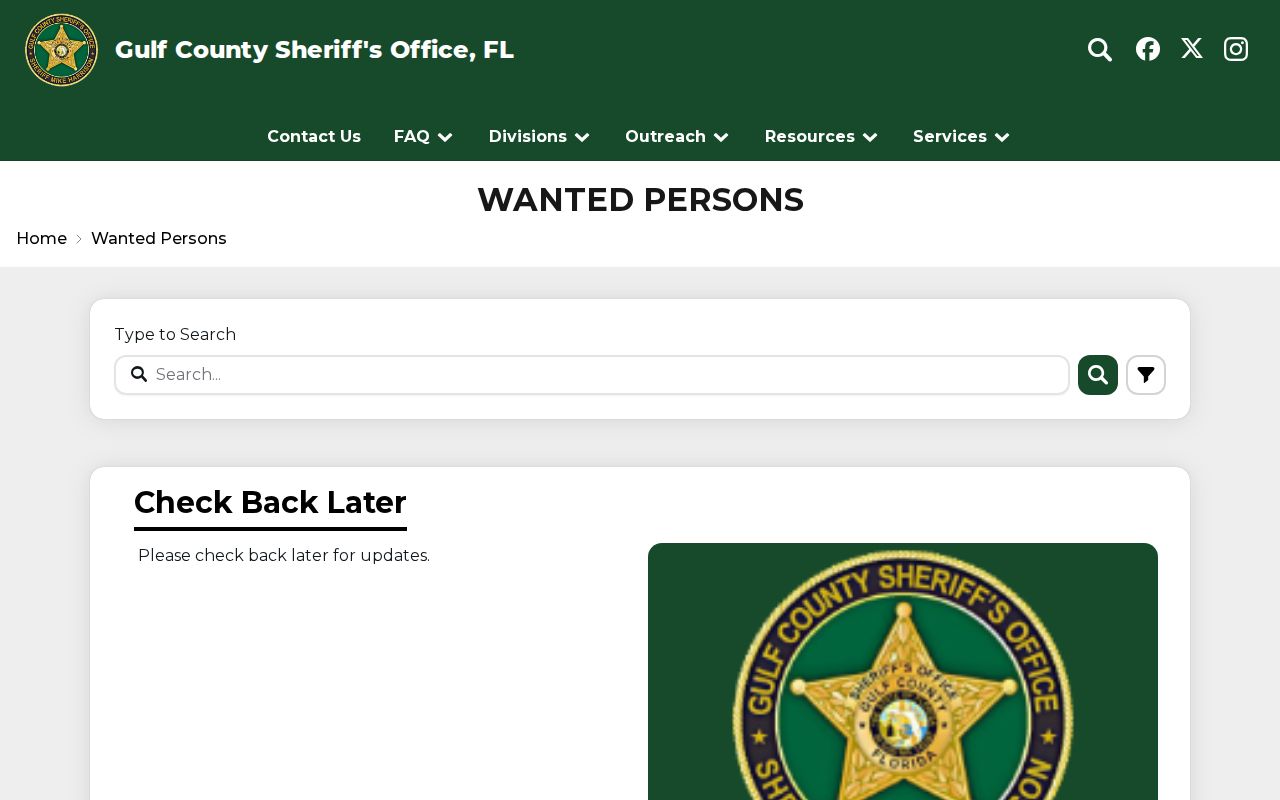
An image of the search source can document the page and its blank state without rehosting any wanted person's photo. Note: An empty public wanted list is not an official clearance of a name or proof that no warrant exists.
Gulf County Wanted Listing Fields
With no Gulf County wanted profile posted, the field table below splits confirmed page facts from details nobody has established. That line matters. Plenty of wanted pages elsewhere follow similar layouts, but no field belongs to Gulf County by guesswork. When a profile does appear, reread the official page and treat each item as agency-supplied information that can change.
| Field | What the Gulf County Source Established |
|---|---|
| Current list status | “Check Back Later,” with zero public profiles on August 16, 2026 |
| Name | No name field could be verified while the list was empty |
| Photograph | No standard wanted-photo field could be confirmed from an active profile |
| Warrant or charge basis | No standard label or level of detail was established |
| Description or last known area | Not established by the empty page |
| Publication date or cadence | No update schedule or profile date standard was published |
Listings vanish for several reasons. An arrest, a court action, or a simple agency decision can all remove one, and the page itself won't say which. If a profile you saw disappears, confirm the current status with GCSO and check the clerk docket rather than trusting a saved image or an old repost.
Read Gulf County Wanted Listings
Think of the wanted page as a public-safety bulletin, not a court file. Read it in a short, careful sequence. Keep every contact at a safe distance, and hand what you know to law enforcement instead of posting it in public comments. A profile is never a green light to locate, follow, question, or detain anyone yourself.
- Open the official GCSO Wanted Persons page and note its current date and status.
- Read only the identifiers and caution details the sheriff actually supplies. Do not match a person from appearance alone.
- If you recognize a listed person or place, do not approach. Use GCSO, the sheriff app, or Panhandle Crime Stoppers.
- For arrest activity after a capture, use the Gulf County booking and custody channels. The recent-arrest page, current-inmate app, detention facility, and court docket answer different questions.
- Check the Gulf Clerk docket for filed charges and disposition. A booking charge can be changed, declined, dismissed, or resolved later.
GCSO's wanted list sits before an arrest. Its Arrests page follows selected arrests, the official app covers current detention, and the clerk record follows prosecution. Four stages, four separate answers. A name missing from one stage settles nothing about the others.
Check Gulf County Warrants
Gulf County has no verified public warrant-search portal. The most wanted page is curated, so it can sit empty while active warrants exist. The internal FCIC and NCIC systems are criminal-justice tools, not public search sites. A direct confirmation beats any web name search here.
- Call the Gulf County Sheriff's Office main or non-emergency line at 850-227-1115. In Wewahitchka, use 850-639-5717.
- Give enough identifying information to avoid a same-name error. Ask what the office can confirm and how the person should address the matter safely.
- Search the Gulf County Clerk record gateway for a related public case. A docketed capias or warrant event may appear, but a docket miss is not clearance.
- If the matter may concern the caller, speak with an attorney or the court before taking action. Follow official directions for a safe appearance or surrender.
- Keep the agency response and case number. Recheck the clerk record for later disposition.
The clerk holds the court records, while GCSO confirms whatever law-enforcement information it can release. Neither office gets replaced by an unofficial people-search result. A warrant is simply a court command, usually to arrest. Note: Online records can lag, and public dockets can omit sealed or restricted material, so direct official confirmation remains the safest check.
Gulf County Warrant Types
Different court events produce different orders. The labels below cover broad functions without claiming which type fits any person. Read the actual court entry, and ask counsel or the issuing court about its effect. A wanted-page headline never defines the order.
| Type | General Purpose | Safe Next Step |
|---|---|---|
| Arrest warrant | A judge authorizes arrest based on a stated legal basis. | Confirm with GCSO and address it through counsel or court. |
| Bench warrant | A court issues an order tied to failure to comply with a court requirement. | Contact counsel or the issuing court for lawful resolution. |
| Capias | A court command directs that a person be taken into custody; it may appear as a docket event. | Verify the case and follow court or attorney instructions. |
| Out-of-county warrant | Another jurisdiction may have issued the order. | Ask which agency and court own the record before acting. |
A public wanted profile is not its own warrant type. It's an agency publication, chosen for investigative or public-safety reasons, and most warrants never appear there at all.
Gulf County Tip Channels
Tips about a Gulf County wanted person can go straight to GCSO, through its official app, or to Panhandle Crime Stoppers. A GCSO release describes anonymous Crime Stoppers reporting with a possible reward of up to $1,000. That money isn't automatic. Rewards hinge on the case and program rules, so assume nothing and promise nothing.
Gulf County Sheriff's Office
418 Cecil G. Costin Sr. Blvd.
Port St. Joe, FL 32456
850-227-1115
Wewahitchka: 850-639-5717
Panhandle Crime Stoppers
850-785-TIPS (8477)
Anonymous tips; rewards may be case-specific.
Report what you truly saw. Give the place, the time, the direction of travel, and any vehicle detail. Skip the guesswork. If a threat is urgent or a crime is happening now, call 911 rather than a web form or app tip.
Gulf County Warrant App Tips
The sheriff's office app gives Gulf County residents one more way to send tips about wanted people. It is free. Grab it for iOS or Android. The listed features go well beyond tips. You get current-inmate search, recent arrests, news, sex-offender lookup, public resources, and alerts. Weather and traffic notices come through it too. So it works as a countywide tool rather than a narrow jail app.
That breadth helps once a wanted person is picked up. The wanted page might drop the entry. A recent-arrest item may appear. The app's inmate search can show someone currently in custody. Still, the store description does not promise photos or every booking field. When custody truly matters, confirm it with the Gulf County Detention Facility. A prison sentence imposed later shows up in the Florida Department of Corrections offender search instead. And tips never replace 911.
One launch feature deserves mention too. Victim notifications alert a registered person when an offender's custody status changes. For court dates and final outcomes, the Gulf Clerk docket is the place to look.
Resolve Gulf County Warrants Safely
Think a Gulf County warrant has your name on it? Do not use the wanted list to dodge police. Call an attorney or the issuing court first. A lawyer can verify the case, explain what the order says, and arrange a lawful appearance or surrender if one is needed. GCSO, for its part, can give whatever official confirmation it is allowed to release.
First appearance comes next after any arrest. Florida requires that hearing within 24 hours. There, a judge lays out the charge and sets release terms. Do not expect the web to update on the same clock. Pull the clerk case with the exact name or case number, then track the docket through plea, dismissal, trial, or judgment. Booking charges can shift as the case moves forward.
Same-name matches demand extra care. Write down the case number, issuing court, and named agency from the official source before assuming the order targets the right person. The sheriff line handles law-enforcement confirmation. The clerk handles public docket access and copies. A stale screenshot or an unofficial repost proves nothing about whether a warrant stays active. If counsel sets up an appearance, follow those instructions and bring the identifiers requested. Never send a friend or relative to test whether officers are watching for someone.
Handled this way, resolution keeps everyone safer. It heads off false matches and prevents private confrontations. It also puts the question before the agency, lawyer, and court equipped to answer it.